The Hidden Discipline Behind Startup Scouting: Translating Risk, Readiness, and Reality
A guide to innovation scouting for corporate readiness and real-world innovation needs
Startup scouting is often misunderstood. Many assume it’s simply about identifying startups that “fit the brief”, while in practice, it’s far more intricate. True scouting is less about search and more about synchronization between a corporate’s strategic context and a startup’s capacity to deliver.
As an accelerator deeply involved in venture clienting programs in select markets, and running various startup initiatives across 21+ countries, we’ve learned that access to data is the easy part. The real differentiator lies in how well one can interpret, translate, and adapt to the unique realities of each corporate environment.
Understanding Risk Appetite: The Cornerstone of Effective Scouting
Before the first startup is even shortlisted, we analyze the corporate’s innovation risk profile. Our Open Innovation Readiness Assessment evaluates elements such as R&D velocity, governance flexibility, technical bandwidth, and market responsiveness.
But frameworks alone don’t reveal the full picture. Risk appetite often shows up subtly: In the phrasing of a challenge statement, the discomfort around uncertainty, or the way decision-makers frame “failure.”
Some corporates prefer evidence over exploration; they require exhaustive validation before considering engagement. Others are more open to experimentation, especially when strategic alignment outweighs immediate technical precision.
We’ve encountered corporates whose problem statements were so narrowly defined that they had effectively engineered out innovation from the start. In those moments, our role isn’t to push, but to recalibrate: to show, through data and dialogue, how broadening the scope can create more meaningful opportunity without diluting intent.
When Appetite and Alignment Diverge Within the Same Corporate
Even within a single organization, risk tolerance varies widely. Procurement may demand compliance, while the innovation team advocates for speed. Legal departments safeguard continuity, while R&D units push for frontier technologies.
Without alignment across these internal actors, innovation efforts rarely move beyond pilot discussions. That’s why part of our early work involves identifying internal champions: individuals who can bridge silos and sustain momentum.
We also design workshops and internal sessions to align expectations, clarify approval pathways, and equip teams to engage constructively with external innovators. Because no amount of scouting precision can compensate for internal misalignment.
Beyond Databases: Scouting Through the Invisible Networks
Anyone can access Crunchbase, Dealroom, or PitchBook. The difference lies in how you interpret and extend beyond them.
Our teams operate across 21+ innovation ecosystems, from research clusters in Singapore to early-stage accelerators in emerging markets. Through years of consistent collaboration with venture funds, universities, and government programs, we maintain a live, trust-based network that surfaces innovation before it becomes visible on any database.
We spend time in the field: in demo days, deep tech showcases, and corporate innovation gatherings, because proximity matters. It allows us to identify early traction, unpolished prototypes, and unconventional solutions that haven’t yet hit the mainstream radar.
Scouting isn’t about being plugged in; it’s about being present.
Remaining Problem-Driven, Not Portfolio-Driven
It’s tempting to rely on alumni startups as the default shortlist, but that’s a shortcut we actively avoid. Alumni are part of our longlist, never the endpoint.
Our scouting process follows what we call the PS2X Method: our Parallel Scouting and Sourcing Method, where we activate both inbound and outbound channels with consistent messaging anchored in the corporate’s defined challenge statement. This dual-track approach maintains objectivity while expanding reach.
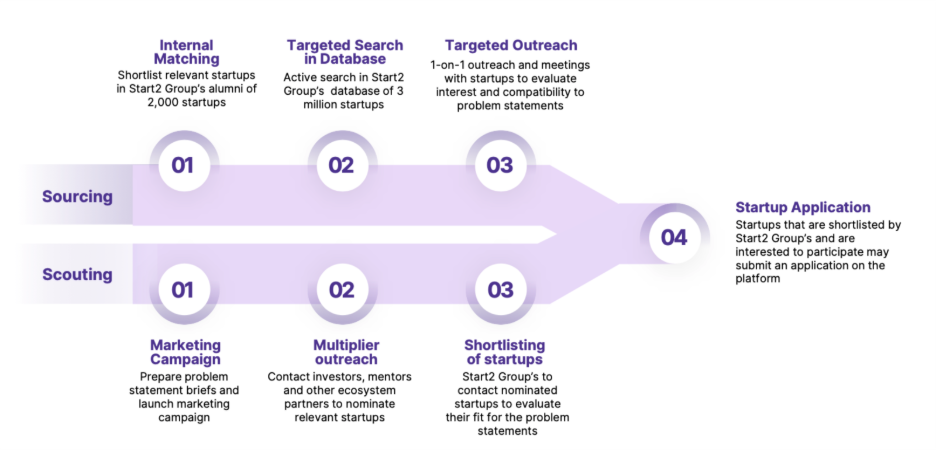
A recurring pattern we’ve observed: corporates that over-specify technical requirements too early often signal a lower readiness for open innovation. Conversely, those that frame problems around outcomes and strategic priorities tend to engage more productively and with greater openness to co-development.
We’ve found that in some cases, based on the pain points and needs identified along the process of challenge definition, the scope can be expanded to scouting not just technology startups, but also small and medium enterprises (SMEs).
Our role is to recognize where the corporate stands, and tailor our methodology accordingly.
Translating Between Two Operating Realities
Scouting is often mistaken for only sourcing startups. In reality, it’s an act of translation between two fundamentally different operating systems: the corporate and the startup.
Corporates operate on predictability, scale, and compliance. Startups operate on speed, iteration, and resource constraint. The friction between the two is not a problem to solve but a dynamic to manage. Our work lies in calibrating both sides’ expectations, ensuring the dialogue is not just transactional but strategically meaningful.
Preparation on both ends is key. Startups receive structured guidance and briefing materials to communicate effectively with business units. Corporates are briefed to align internally before the first touchpoint. The result: sharper discussions, realistic timelines, and fewer lost opportunities to miscommunication.
When the Problem Statement Evolves, and Why That’s Healthy
The most productive programs are rarely the ones where the brief stays static. When corporates begin to reframe their challenge mid-process, it’s often a sign of maturity, an acknowledgment that the market is offering feedback.
We present scouting outcomes not as lists but as insight layers: patterns in technology readiness, regional maturity, and potential adjacencies. These insights frequently lead to the reframing of objectives, which in turn lead to better-fit collaborations.
As the problem statement evolves and we dive deeper into the market landscape, opportunities may also take on different forms along the way. Sometimes, the target approach may not just require one startup with a ready solution but may require enrichment of the solution through 1) further development of the product simultaneously with the project, and/or 2) involving multiple sources of solutions to co-develop together.
In this sense, scouting is as diagnostic as it is delivery oriented. It not only surfaces startups, but it also reveals what the market can and cannot currently offer.
Scouting as Partnership, Not Procurement
Ultimately, effective scouting isn’t a service transaction. It’s a partnership built on shared curiosity, mutual learning, and calibrated ambition.
Our approach is pragmatic: we meet corporates where they are, respect their constraints, and design engagements that move them one step further in their innovation maturity. Not ten steps beyond it.
Because the measure of good scouting isn’t how many startups you can find, but how many you can make work.
Explore more resources



Ready to start your innovation journey?
Let’s connect and explore what’s possible – together.